
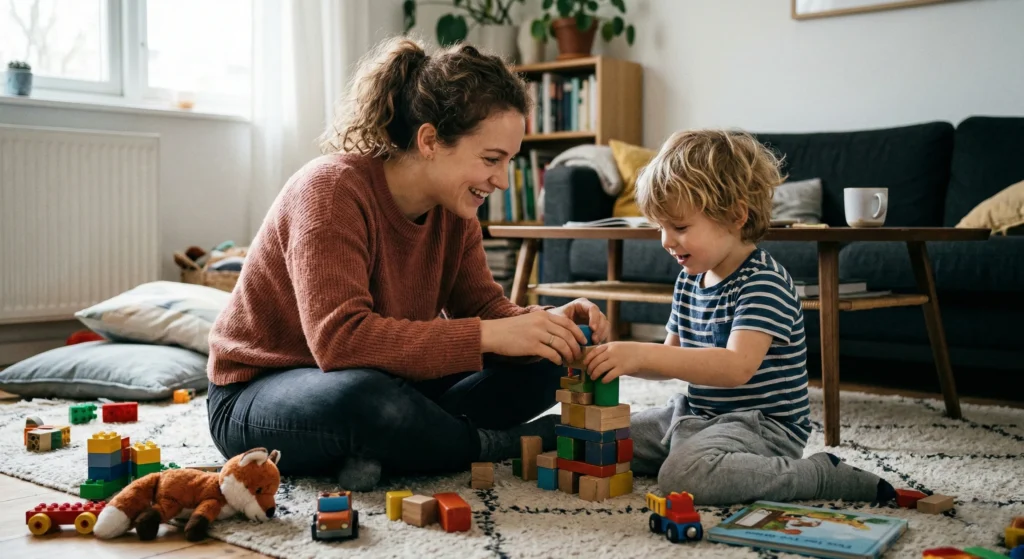
Parents looking for ways to support their child’s development often face an overwhelming number of therapy options. It can feel confusing to know what will truly help.
DIR/Floortime offers a different approach. Rather than a set of exercises, it is a philosophy that meets children where they are, using their natural emotions and relationships to foster growth.
DIR stands for Developmental, Individual-differences, Relationship-based. The model focuses on supporting emotional, social, and cognitive development by understanding each child’s unique needs.
Developed by Dr. Stanley Greenspan and Dr. Serena Wieder, DIR/Floortime has been a cornerstone of developmental therapy for decades.
In this blog post, we’ll explore how DIR/Floortime works in practice, break down its core components, and share strategies for using Floortime to support communication, emotional growth, and social skills in children.
Breaking Down the DIR Model: The Three Core Components
Before learning how to implement Floortime, it helps to understand the framework behind it. The DIR model looks at three important elements that guide how therapists, caregivers, and professionals—including those in physical therapy—support a child’s development.
D – Developmental Capacities (The Six Functional Emotional Milestones)
In the DIR model, development is not measured only by academic skills or cognitive milestones. Instead, it focuses on how children build emotional connections, communicate with others, and interact with the world around them.
These abilities develop in stages, known as the Functional Emotional Developmental Levels (explained in detail later below), which form the foundation for learning, social skills, and communication.
Children start by learning to stay calm and attentive, gradually forming connections with caregivers and engaging in simple back-and-forth interactions.
Over time, they begin solving problems through longer chains of interaction, use pretend play to express emotions, and eventually make logical connections in their thinking. These stages provide a helpful framework for understanding a child’s growth without needing to go into full detail here.
I – Individual Differences (Sensory Processing & Biology)
Every child experiences the world in their own way. The DIR model recognizes that differences in sensory processing, motor planning, and biology shape how a child learns and behaves.
Some children are more sensitive to sounds, lights, or movement, while others seek extra sensory input. For example, a child who covers their ears may not be refusing to participate but simply feel overwhelmed by noise. Understanding these differences helps caregivers and therapists respond with empathy.
Professionals in speech therapy, occupational therapy, and physical therapy often work together to understand each child’s sensory and motor needs.
Adapting the Environment to Support Your Child
When adults understand a child’s sensory profile, they can adjust the environment to help the child feel safe and regulated. Small changes, like reducing noise, creating a calm play space, or adding movement breaks, can make a big difference.
These adjustments help children stay engaged, communicate more comfortably, and participate more fully in Floortime interactions. Supporting a child’s sensory needs makes learning and connection easier.
R – Relationship-Based (The Power of Connection)
The final piece of the DIR model focuses on relationships. In Floortime, meaningful relationships with caregivers and therapists are the main pathway through which development happens.
Research shows that higher quality caregiver‑child interaction, including warm, responsive engagement, is linked with better social and emotional outcomes in early childhood, helping children form secure attachments and supporting developmental growth.
Children grow emotionally and socially when they feel safe, understood, and connected. Through playful interactions, shared joy, and emotional engagement, adults help children move through developmental stages and build stronger communication skills.
The role of caregivers and therapists is to guide interactions using emotion, connection, and responsive communication.
Caregivers (Parents and Family Members)
Parents play a central role because they interact with their child throughout the day. By following the child’s lead, showing warmth, and responding to communication attempts, they help create many opportunities for connection and learning.
Therapists and Developmental Professionals
Therapists support both the child and the family by modeling Floortime strategies. Specialists such as speech therapists, occupational therapists, and physical therapy professionals, work together to help children build communication, emotional regulation, and motor skills through relationship-based play.
What is Floortime? Putting the DIR Model into Practice
Floortime is the practical side of the DIR model. It turns theory into real interactions where children learn through play and connection. By engaging in Floortime, caregivers and therapists help children develop emotional, social, and communication skills in a natural, supportive way.
The Core Principle: “Meeting the Child Where They Are”
Floortime is all about following the child’s lead. Instead of directing or controlling play, it encourages adults to enter the child’s world and connect on their terms.
This child-led approach builds trust and makes learning feel fun, not forced. By tuning into what the child is interested in, you can support emotional growth while communicating with your child in meaningful ways.
Best Techniques for Floortime Sessions
Floortime sessions work best when simple strategies are applied consistently. These techniques help expand interaction, encourage problem-solving, and foster deeper communication.
- Opening Circles of Communication: Notice that even small actions are often intentional. Responding to these cues supports back-and-forth interaction and builds a sense of understanding.
- Affect and Animation: Using lively expressions and an animated tone draws attention naturally. It makes interactions more engaging and exciting for the child.
- Playful Obstruction: Gently interrupting a child’s routine play encourages problem-solving. For example, if a child rolls a car, placing it somewhere unexpected can prompt requests or gestures to retrieve it.
- Extending and Elaborating: Follow the child’s lead, but add new elements to expand the play. This can introduce new vocabulary, actions, or social ideas while keeping the play fun.
- Imitation and Turn-Taking: Mirroring the child’s actions and taking turns creates shared enjoyment. It reinforces communication skills and helps the child feel seen and understood.
These techniques are often emphasized in parent training, helping families feel confident in supporting growth at home.
Setting Up the Environment for Success
Creating a Floortime-friendly space makes the sessions smoother and more enjoyable. Remove distractions and provide open-ended toys that allow creativity.
Consider the child’s sensory preferences when arranging the environment. Soft lighting, quiet areas, or access to movement can make it easier to engage fully. A supportive space helps children focus, explore, and practice new skills in a safe and playful setting.
The Six Functional Emotional Development Milestones
Understanding where a child is in their emotional development helps guide supportive interactions. These milestones show how children grow from basic regulation to complex thinking and play.
Research on the DIR/Floortime model describes these stages as a developmental “ladder” that supports social, emotional, language, and cognitive growth in early childhood.
Level 1: Regulation
At this stage, children are learning to stay calm and focused. They show interest in sights, sounds, and their environment. Supporting regulation helps children explore safely and sets the stage for learning healthy habits during the holidays and beyond.
Level 2: Intimacy
Children begin forming strong emotional connections and find joy in interacting with caregivers. Smiling, cuddling, and shared laughter are signs that they are engaging socially. These moments of intimacy help strengthen attachment and communication.
Level 3: Two-Way Communication
Children start to open and close circles of communication through gestures, sounds, and taking turns. Simple interactions like pointing, nodding, or making a sound in response are important milestones. Activities that encourage helping a child complete their words can support progress at this level.
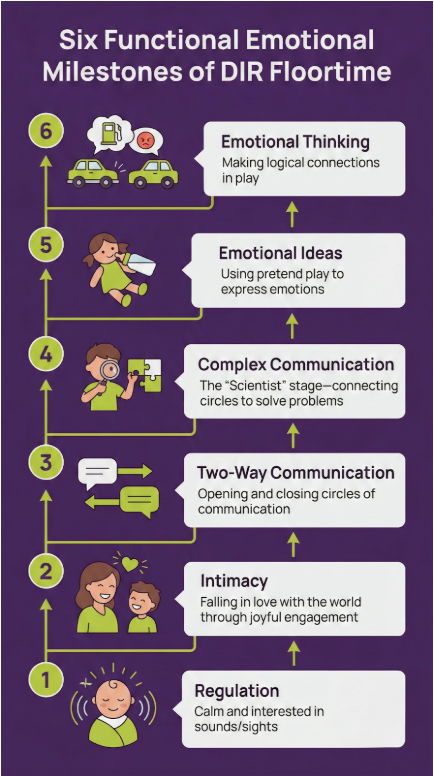
Level 4: Complex Communication
At this “Scientist” stage, children connect multiple interactions into longer chains of problem-solving. They might figure out how to get a toy or communicate a need through a series of gestures and actions. Caregivers can encourage back-and-forth play that builds reasoning and social skills.
Level 5: Emotional Ideas
Pretend play becomes a key way for children to express emotions. They may feed a doll, have cars “talk” to each other, or create imaginary scenarios. These activities also support fine motor skills as children manipulate toys and objects in play.
Level 6: Emotional Thinking
Children make logical connections in their play, linking causes and effects. For example, they might say, “The car is angry because it ran out of gas.” This level shows the child is thinking about emotions and reasoning simultaneously, preparing them for more complex social understanding.
Quick Checklist for Parents
Here’s how to know what milestone your child is currently operating at:
- Shows calm focus and interest in surroundings (Level 1)
- Engages joyfully with caregivers (Level 2)
- Uses gestures or sounds to communicate back-and-forth (Level 3)
- Connects multiple actions to solve problems (Level 4)
- Engages in pretend play to express ideas or emotions (Level 5)
- Makes logical connections in play and reasoning (Level 6)
DIR Floortime and Autism Spectrum Disorder (ASD)
DIR Floortime is very effective for children on the autism spectrum because it focuses on understanding the emotional meaning behind behaviors instead of just trying to stop them.
Research shows that Floortime can improve social engagement, communication, and emotional functioning in children with ASD. For example, a review found that home-based Floortime helped children develop communication skills and strengthened parent-child interaction.
Another study showed that children who received regular Floortime sessions over a year made meaningful developmental progress and showed reduced autism severity. By focusing on connection, Floortime helps build joint attention, social back-and-forth, and symbolic thinking in a natural and engaging way.
DIR/Floortime vs. Other Therapies (Comparison)
Parents often wonder how Floortime compares with other therapies used to support child development. Each approach has a different focus and method, but many of them can work well together to support a child’s growth.
Floortime vs. Applied Behavior Analysis (ABA)
DIR/Floortime is relationship-based. It focuses on building emotional connection and helping children develop the internal foundations needed for learning. The approach is child-led, meaning the adult follows the child’s interests and uses play to expand interaction and communication.
Applied Behavior Analysis (ABA) takes a behavior-based approach. Sessions are often therapist-led and use structured activities such as discrete trial training. The main goal is to shape specific behaviors by reinforcing desired responses.
Both approaches aim to help children learn important skills. Floortime focuses more on emotional engagement and natural interaction. ABA focuses more on measurable behavioral outcomes.
Floortime vs. Speech or Occupational Therapy
DIR/Floortime is often used alongside other therapies rather than replacing them. Many families combine Floortime with speech therapy, occupational therapy, or even physical therapy to support different areas of development.
Occupational therapy addresses sensory processing and motor planning. This supports the “Individual Differences” part of the DIR model by helping children regulate their sensory systems and improve fine motor skills needed for play and daily tasks.
Speech therapy focuses on language, social communication, and pragmatics. Floortime sessions create natural opportunities for communicating with a child, practicing turn-taking, and even helping a child complete their words during playful interaction.
Together, these therapies support communication, emotional development, and everyday learning.
How to Get Started with DIR/Floortime
Starting Floortime does not require complicated equipment or a strict routine. It begins with simple interactions that help build connection and communication.
- Observation: Spend time watching your child during play. Notice what captures their interest and how they respond to sounds, movement, and different activities.
- Join In: Enter your child’s play instead of directing it. If they are stacking blocks, hand them another block. If they are lining up cars, offer another car and follow their lead.
- Find a Professional: A trained specialist can guide you in using Floortime effectively. You can search for certified DIR/Floortime practitioners or training programs through resources like ICDL.
- Parent Training: Parents play the most important role in this approach. Therapists often focus on coaching families so they feel confident supporting their child’s development during everyday interactions.
Frequently Asked Questions about DIR Floortime
How many hours of Floortime are recommended?
The amount of Floortime can vary depending on the child’s needs. Many experts recommend multiple short sessions throughout the day instead of one long session. Even small moments of play and interaction can support communication and emotional development.
Can Floortime be done in a school setting?
Yes, Floortime can be used in classrooms and therapy settings. Teachers and therapists can incorporate child-led interactions during play, learning activities, and social time to support engagement and communication.
At what age can you start Floortime?
Floortime can begin very early, even in infancy. Early interaction helps build foundational skills like attention, engagement, and social connection.
Is there scientific evidence supporting DIR/Floortime?
Research shows that Floortime can improve communication, emotional development, and parent-child interaction for many children. Studies also suggest that regular Floortime sessions may help reduce the severity of autism-related challenges over time.
Can parents practice Floortime at home?
Yes, Floortime is designed to be used in everyday routines at home. With guidance from therapists or parent training, caregivers can support learning through simple play, shared attention, and communicating with your child during daily activities.
Verdict: How Effective is DIR Floortime?
DIR/Floortime is a journey of joining a child in their world so they can gradually learn to navigate ours. By following their interests and building meaningful interactions, caregivers help children develop communication, emotional understanding, and social confidence.
Small moments of connection during everyday play can have a powerful impact on a child’s brain development and emotional health. Simple interactions like shared laughter, turn-taking, and responding to a child’s cues can help strengthen relationships and support long-term growth.
If you would like guidance on implementing DIR/Floortime or want support tailored to your child’s needs, professional help can make the process easier and more effective. Our team at Communication Clubhouse is here to help. Contact us today to schedule a consultation and learn how we can support your child’s developmental journey.