
If your child’s therapist has mentioned a standing frame or a gait trainer, you’re not alone in feeling unsure about what each one does. To many parents, they look similar. Both support your child’s body. Both are used in therapy. Both seem important.
So what’s the real difference?
At the most basic level, standing frames focus on stationary weight-bearing, while gait trainers focus on the mechanics of walking. One helps your child “stay” upright. The other helps them “go.”
Parents often tell us they want to support their child’s physical development but aren’t sure which tool targets which milestone. That’s completely understandable. Mobility equipment can feel overwhelming at first.
In this guide, we’ll walk you through the benefits, differences, and how these tools can work together in a comprehensive therapy plan. At The Clubhouse in Chicago, our credentialed and board-certified therapists collaborate across physical therapy, occupational therapy, speech therapy, and ABA therapy to ensure your child’s treatment plan is coordinated, thoughtful, and evidence-based.
And if you’re ready to explore what’s best for your child, schedule your first conversation with the therapists at The Clubhouse today.
What Is a Standing Frame? (The “Stay” Tool)
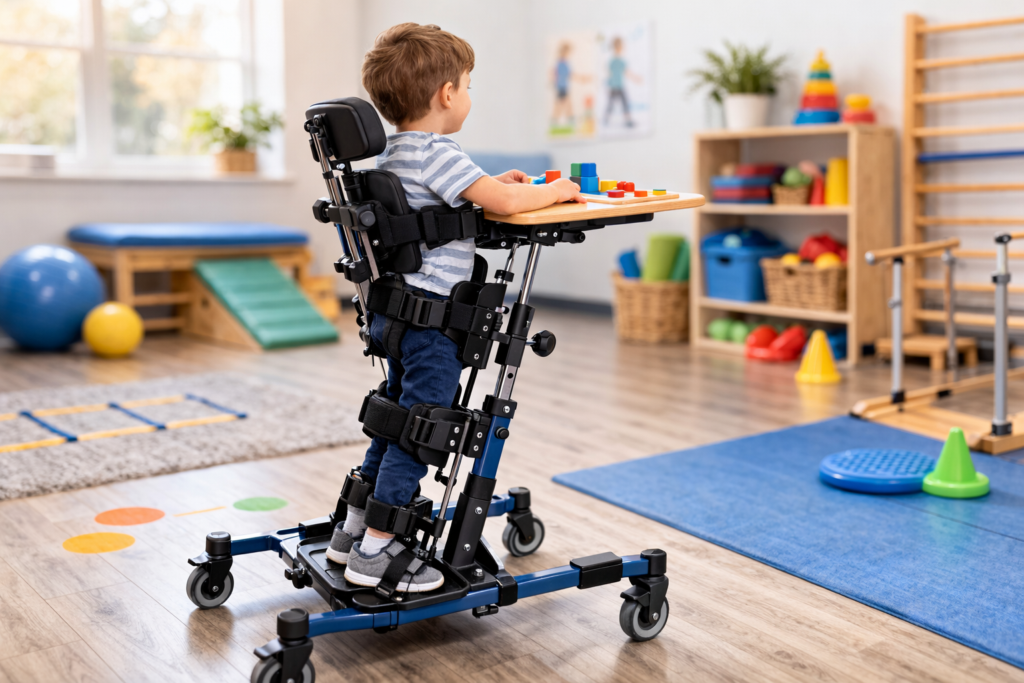
A standing frame is a piece of assistive technology designed to support a child in an upright, vertical position. It allows children who cannot stand independently to safely bear weight through their legs.
Standing frames are typically stationary. Your child is positioned with supportive straps and alignment systems that keep their hips, knees, and trunk in proper position. The goal isn’t walking. It’s healthy, supported standing.
Who It’s For
Standing frames are often recommended for children who:
- Have low muscle tone
- Experience balance challenges
- Have neurological conditions
- Are not yet able to stand independently
Key Benefits
Bone Density
Weight-bearing is essential for bone development. Children who spend much of their day seated may not receive enough natural stimulation for healthy bone growth. Standing supports stronger bones over time.
Hip Development
Proper alignment in a standing frame can help reduce the risk of hip subluxation and promote healthier joint positioning.
Digestion & Circulation
Being upright supports digestion and improves blood flow. Many families notice increased comfort when standing is incorporated consistently.
Social Interaction
Standing brings your child to eye level with peers and adults. That shift can make classroom participation, family conversations, and play more engaging and inclusive.
At The Clubhouse’s North Mayfair location in Chicago, our licensed physical therapists integrate standing frames into individualized plans. Because we offer a wide variety of therapies under one roof, our therapists collaborate to ensure standing time also supports communication, classroom readiness, and functional goals.
What Is a Gait Trainer? (The “Go” Tool)
If the standing frame helps your child stay upright, the gait trainer helps them move.
A gait trainer is a mobile, wheeled device that provides partial weight support and postural stability so a child can practice walking. Unlike a standard walker, gait trainers provide more trunk and pelvic support for children who need help maintaining upright posture.
How It Differs From a “Walker”
Traditional walkers assume a certain level of balance and trunk control. Gait trainers are designed for children who need more structured support. They often include pelvic supports, trunk prompts, and harness systems that allow safe stepping practice.
Key Benefits
Motor Learning
Walking is a complex skill that requires repetition. Gait trainers allow children to practice coordinated stepping in a supported environment.
Independence
Mobility opens doors. Even supported movement allows children to explore their environment, move toward preferred activities, and engage more actively in therapy.
Cardiovascular Health
Increased physical activity supports endurance and overall health. Practicing walking builds stamina over time.
The physical therapists at The Clubhouse coordinate closely with occupational and speech therapists when incorporating gait trainers. For example, stepping practice might be paired with communication goals or classroom-based functional skills, ensuring therapy sessions are meaningful and integrated.
We can help you explore the right path for you and your child. You can schedule a free consultation today to get started.
Standing Frames vs. Gait Trainers: The Comparison
Here’s a quick-glance breakdown of how these tools differ:
| Feature | Standing Frame | Gait Trainer |
| Primary | Posture & Weight-bearing | Mobility & Walking |
| Movement | Stationary (usually) | Mobile (on wheels) |
| Muscle Focus | Core stability and bone health | Leg coordination and endurance |
| Therapy Phase | Often used for foundational strength | Used for active gait training |
While both devices support physical development, they serve different roles within a therapy plan.
Can a Child Use Both?
Yes. In many cases, children benefit from using both devices at different times.
These tools are not mutually exclusive.
For example, a child may use a standing frame at home for 45 minutes during homework or play to build bone density and promote alignment. During physical therapy sessions, that same child might use a gait trainer to work on stepping mechanics and endurance.
This “hybrid” approach allows therapists to build foundational strength first, then apply that strength to active movement.
The Clubhouse provides multiple therapies in one collaborative setting, and our therapists regularly communicate about progress. If a child’s trunk strength improves in occupational therapy, the physical therapist may adjust gait trainer support. If endurance increases, standing duration may change.
That level of coordination helps ensure your child’s plan evolves with their growth.
How to Choose the Right Device for Your Child
Choosing the right mobility tool starts with a thorough evaluation by a licensed physical therapist. All therapists at The Clubhouse are credentialed and board-certified, something that not every practice has. Our PTs are highly trained, and are able to perform a comprehensive assessment of your child’s abilities before recommending any equipment.
This way, your child is set up for success right from the start to become the best possible version of themselves. We’ll establish baseline data and can track improvements across our wide range of therapies to find what works best for your child for long-term success and future independence.
Assessment Criteria
Current Mobility Level
Can your child bear weight independently? Do they initiate stepping? How much trunk support is required?
Specific Therapeutic Goals
Are you hoping your child can walk in the park? Improve classroom participation? Spend less time sitting? Clear goals guide equipment recommendations.
Insurance and “Letter of Medical Necessity” (LMN)
Many devices require detailed documentation for insurance approval. A licensed PT prepares a Letter of Medical Necessity that outlines why the equipment is clinically appropriate. Proper credentials ensure that documentation is accurate and effective.
No recommendation is made in isolation. The Clubhouse’s physical therapists work with therapists of other specialities, collaborating to ensure that any recommended mobility tools support your child’s full developmental picture.
Verdict: In Which Cases Should Your Child Use These Mobility Tools?
There isn’t a one-size-fits-all answer.
Some children primarily need supported standing to improve bone health and posture. Others are ready to focus on walking practice. Many benefit from both at different stages of development.
What matters most is having a knowledgeable, collaborative team guiding the decision. Instead of fragmented care, you receive a coordinated plan designed specifically for your child.
Standing tall. Taking steps. Building strength. Gaining independence. The right equipment, recommended by the right team, can truly change a child’s daily experience.
If you’d like to learn whether a standing frame, gait trainer, or another mobility support may benefit your child, we’re here to help. Schedule a Child Therapy Consultation and begin with a thoughtful, collaborative evaluation designed around your child’s goals.